 Rugby, United Kingdom Day & boarding · Co-ed Age range 13–18 885 pupils Founded 1567
Rugby School
Founded in 1567, Rugby School is the UK’s leading co-educational true full-boarding and day school for pupils aged 13–18. We are a 7 days-a-week school wit...
About Rugby School
Rugby School was founded in 1567 by Lawrence Sheriff, a London-born grocer who endowed the school under his will to provide a free education to the boys of Rugby and Brownsover. The school remained in relative obscurity until the early nineteenth century, when the reforming headmastership of Thomas Arnold (1828-41) transformed it into the model for the modern English public school. Arnold's emphasis on Christian character, intellectual seriousness, prefectorial responsibility and organised sport became the template that every Victorian public school subsequently emulated. Arnold's regime is romantically and critically depicted in Thomas Hughes's autobiographical novel Tom Brown's School Days (1857), set at Rugby in the 1830s. Rugby is one of the original nine Clarendon Schools defined by the Public Schools Act 1868. The school is co-educational and educates around 800 pupils aged 11-18, with full and weekly boarding alongside day provision. The Head Master is Gareth Parker-Jones.
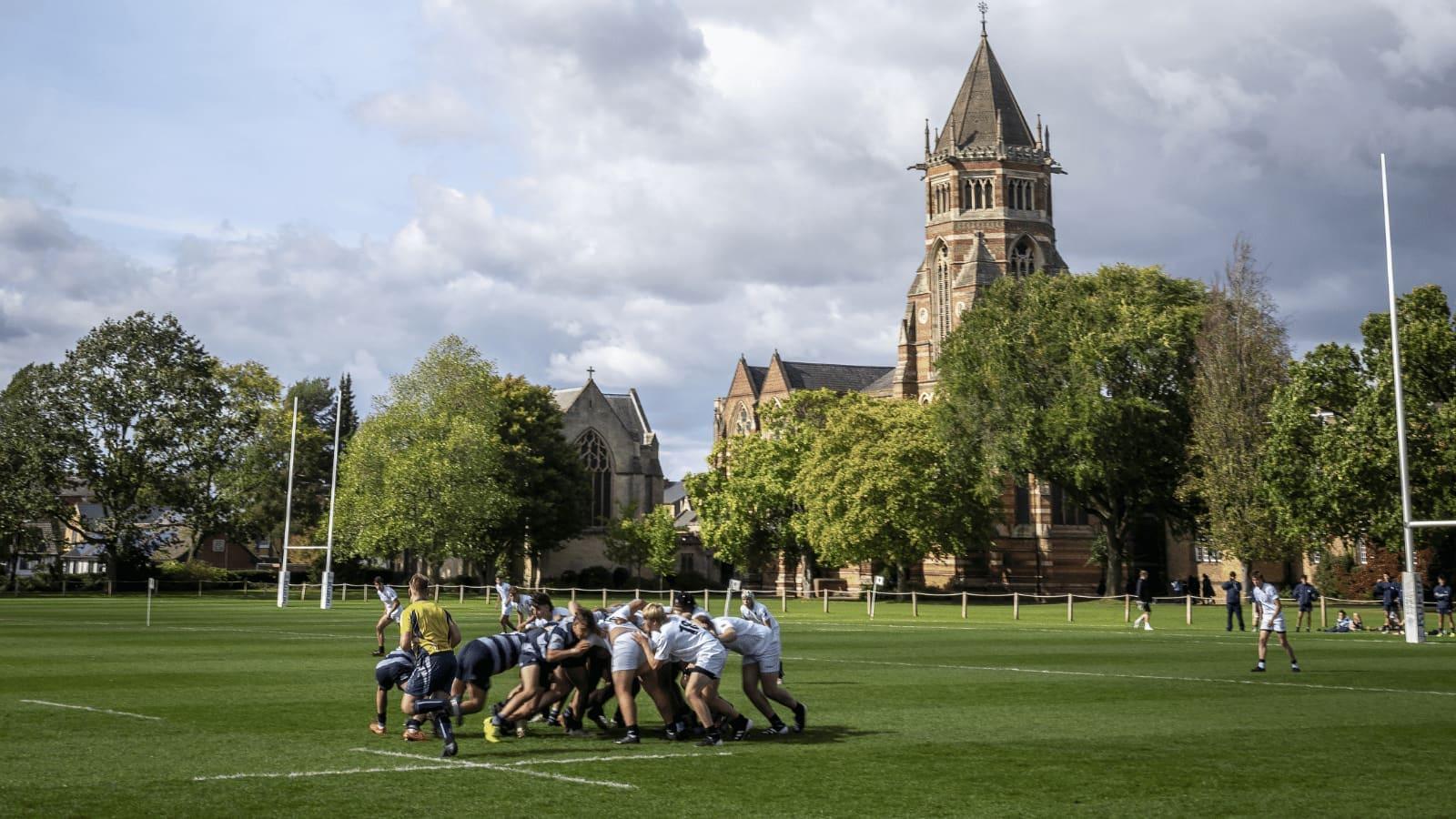
The school's most globally significant contribution is the invention of rugby football. According to school tradition — endorsed by the 1895 commemorative plaque on the Close — in 1823 a boy named William Webb Ellis, "with a fine disregard for the rules of football as played in his time, first took the ball in his arms and ran with it," thereby originating the distinctive feature of rugby union. The Webb Ellis Cup, awarded to the winners of the Rugby Union World Cup, is named in his honour. The school's Close, where Webb Ellis is said to have made his run, remains in active use as a sports ground.
Rugby's alumni list is among the most varied of any English public school. Among prime ministers: Sir Neville Chamberlain, who served as Prime Minister of the United Kingdom from 1937 to 1940 and is remembered for the failed Munich Agreement of 1938. In literature: Lewis Carroll (Charles Dodgson), author of Alice's Adventures in Wonderland; the Victorian poet and critic Matthew Arnold (son of Thomas Arnold); the war poet Rupert Brooke (The Soldier; If I should die, think only this of me); and most recently the Booker Prize-winning Sir Salman Rushdie, who attended Rugby in the early 1960s before reading history at King's College, Cambridge, and whose Midnight's Children, The Satanic Verses and Shame are among the foundational works of late-twentieth-century postcolonial literature.
In music and entertainment: Sir Tim Rice — the lyricist of Jesus Christ Superstar, Evita and The Lion King, and an EGOT recipient (Emmy, Grammy, Oscar, Tony) — was a Rugby pupil. In science: Sir John Boyd Orr OBE, who shared the 1949 Nobel Peace Prize for his work on world nutrition and food security. The school operates a substantial bursary programme via the Rugby School Foundation.
Programmes & strengths
University destinations
Memberships & accreditations
Pupil breakdown
- Boys
- 472 (53%)
- Girls
- 397 (45%)
- SEN support
- 160 (18.1%)
Notable alumni
Frequently asked questions
What type of school is Rugby School?
Rugby School is a co-educational independent mainstream school for pupils aged 13 to 18, located near Rugby in Warwickshire. The school offers education from Senior through to Sixth Form, with pathways leading to GCSEs and A Levels.
How do I apply to Rugby School?
Most families apply to Rugby School 1–2 years before entry, with a process that can include tests, interviews and school reports. See the private school admissions timeline for when to apply and what to expect. https://schoolscout.uk/posts/uk-private-school-admissions-timeline
What are the fees at Rugby School?
Fees for Rugby School vary by year group, with typical termly costs around £12,450.
Is Rugby School a day or boarding school?
Rugby School is a day and boarding school.
Is Rugby School selective?
Admissions to Rugby School are selective, with entry based on overall fit and, where relevant, academic assessment.